
A Simple Guide for Everyday Use
If you have ever looked at a food label and wondered what a number like 850 kilojoules actually means, you are not alone. Kilojoules and calories are both ways of showing energy. Seeing one unit when you are used to the other can make a nutrition label confusing.
The good news kj to calories is that the conversion is quite simple. Once you know the relationship between kilojoules and calories, you can work out the answer yourself in just a few seconds.
What Do Kilojoules Mean?
- “kilojoules” stands for “kilojoule.” It is a unit used to measure energy.
Food gives your body energy, which it uses for activities such as walking, working, exercising, breathing, and even resting. On food labels, especially in countries that use the metric system, this energy is listed in kilojoules.
For example:
- A snack might show an energy value of 600 kilojoules per serving. That number tells you how much energy the serving provides, but it may not mean much if you normally think about food energy in calories.
That is where a kilojoule-to-calorie conversion becomes useful.
What Is a Calorie?
When people talk about calories in food, they normally mean kilocalories, written as kcal.
A food calorie is much larger than the calorie used in physics and chemistry. In nutrition, 1 calorie is equal to 1 kilocalorie.
The relationship between the two units is fixed:
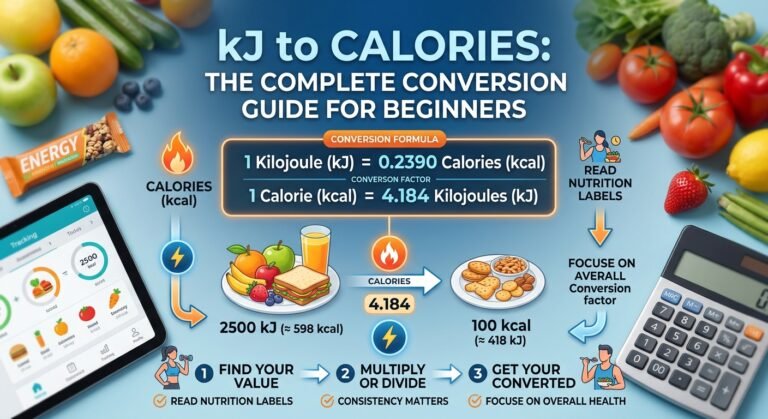
- 1 kcal = 4.184 kJ
So if you have a kilojoule value and want to find the number of food calories, you can divide the kilojoule figure by 4.184.
How to Convert Kilojoules to Calories
The basic formula is
- Calories = kilojoules u00f 7 4.184
You can also use a multiplier:
- Calories: 2248 kilojoules u00d7 0.239
Both methods give essentially the same result, although dividing by 4.184 gives you a more direct calculation.
Example: 500 kilojoules to Calories
Suppose a food contains 500 kilojoules.
- 500 or 7 4.184 = 119.5 Calories
- So 500 kilojoules is 119.5 calories.
You do not need a calculation for everyday use. Just take the number of kilojoules shown on the label. Divide it by 4.184.
Quick kj to Calories Examples
Here are some useful conversions:
key points:
- 100 kilojoules 23.9 kcal
- 200 kilojoules 47.8 kcal
- 300 kilojoules 71.7 kcal
- 500 kilojoules 119.5 kcal
- 750 kilojoules 179.3 kcal
- 1,000 kilojoules 239.0 kcal
- 1,500 kilojoules 358.5 kcal
- 2,000 kilojoules 478.0 kcal
- 2,500 kilojoules 597.5 kcal
- 3,000 kilojoules 717.0 kcal
These figures are rounded for easier reading.
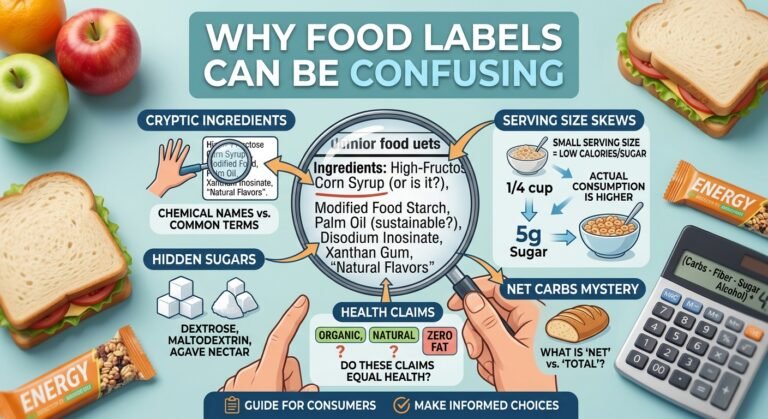
Why Food Labels Can Be Confusing
One reason people get confused is that different countries commonly use energy units on nutrition labels.
- You may see kilojoules on a food package, while a diet app or nutrition guide gives energy in calories. The food itself has not changed. Only the way its energy is being expressed is different.
- Think of it like measuring distance in miles or kilometers. The distance stays the same; only the unit changes.
The same idea applies to kilojoules and calories.
Why Food Labels Can Be Confusing
One reason people get confused is that different countries commonly use energy units on nutrition labels.
- You may see kilojoules on a food package, while a diet app or nutrition guide gives energy in calories. The food itself has not changed. Only the way its energy is being expressed is different.
- Think of it like measuring distance in miles or kilometers. The distance stays the same; only the unit changes.
The same idea applies to kilojoules and calories.
How to Read kilojoules on a Nutrition Label
When checking a food package, pay attention to what the energy figure refers to.
A label may provide energy:
- per serving
- per 100 ml
- package
These values are not interchangeable.
For example:
- if a cereal lists 1,600 kilojoules per 100 g, but your bowl contains 40 g, you should not treat 1,600 kilojoules as the energy in your actual serving.
This small detail can make a difference when comparing foods.
kilojoules to Calories for Foods
You can use the conversion whenever you want to understand the energy listed on a food label.
For instance, if a meal contains 2,000 kilojoules:
- 2,000,0074.184 = 478 Calories
Likewise, a snack containing 300 kilojoules provides roughly 72 calories.
The conversion tells you the energy equivalent. It does not tell you whether a food is healthy or unhealthy. A balanced diet depends on more than one number on a package
Are kilojoules the same as calories?
No. They are units, but they measure the same physical quantity: energy.
The useful relationship is
- 1 calorie (kcal) = 4.184 kilojoules
That means the numerical value in kilojoules is normally larger than the value in calories.
For example:
- 1,000 kilojoules 2248 239 calories
So seeing a larger number in kilojoules does not mean the food suddenly contains more energy. It is simply being expressed using a unit.
A Simple Way to Remember the Conversion
If you only need an estimate, remember this:
kilojoules u00f7 4.2 u2248 calories
For a precise answer, use:
- kilojoules u00f7 4.184
For example:
- 800 kilojoules u00f7 4.184 u2248 191.2 calories
The quick 4.2 method is handy for mental math, while 4.184 is better when you want a precise result.
What About Converting Calories to Kilojoules?
The conversion also works in the direction.
If you know the number of calories. To find the equivalent energy in kilojoules, multiply by 4.184.
- kJ = Calories 7 4.184
For example:
- 250 calories 7 4.184 = 1,046 kilojoules
So the two formulas are easy to remember:
- kilojoules u2192 Calories: divide by 4.184
Calories to kilojoules: multiply by 4.184.
Final Thoughts
Understanding kilojoules and calories does not have to be difficult. Once you know that 4.184 kilojoules equals 1 food calorie, converting between the two becomes a calculation.
The time you see a kilojoule value on a food label, simply divide it by 4.184 to get the approximate number of calories. For estimates, dividing by about 4.2 works well too.
If you regularly compare nutrition labels, learning this conversion can make those numbers much easier to understand.
Frequently Asked Questions
What is the difference between kilojoules and calories?
Both kilojoules and calories are units used to measure the thing: energy. Think of kilojoules and calories like miles and kilometers for distance. The actual energy does not change; only the unit changes. The same logic holds for kilojoules and calories.
How do I convert kilojoules to calories?
To convert kilojoules to calories, divide the kilojoule value by 4.184. That is all. For a mental estimate, divide kilojoules by 4.2 to get a close result.
How many kilojoules are in one calorie?
One kilocalorie, the calorie shown on food labels, equals 4.184 kilojoules. This constant number is useful to remember when reading labels.
What if I need to go the way. Calories to kilojoules?
To convert calories to kilojoules, multiply the calorie number by 4.184. The result is the kilojoules.
What is 500 kilojoules in calories?
Take 500 kilojoules and divide by 4.184. The result is 119.5 calories.
Why does the kilojoule number on a label always look bigger than the calorie number?
Because a kilojoule is a unit, a larger kilojoule number is needed to represent the same energy as a calorie. A bigger kilojoule figure does not mean the food has energy; it merely reflects a different scale.
Does knowing the kilojoule value tell me if a food is healthy?
No. The kilojoule value only shows how energy the food gives. It does not reveal whether the food is nutritious. Sugar, overall nutrient content also matter and a single energy number cannot capture that.
Whats the difference between "per serving" and "per 100g" on a label?
Per serving and per 100g are units and should not be confused. If a label shows energy per 100g but the portion is 40g the 100g figure cannot be applied directly to the 40g serving. Always verify which quantity the label uses before comparing foods.
Is there a trick to remember the conversion?
Yes. For an estimate, divide kilojoules by 4.2. For a value divided by kilojoules, by 4.184.