
kJ to Calories Converter
Quick kJ to Calories Conversion
Convert kilojoules into calories quickly and easily.
If a food label shows energy in kJ and you prefer to think in calories, enter the number into the converter above. You will get the equivalent calorie value without having to work through the formula yourself.
For example:
100 kJ = 23.90 calories; 500 kJ = 119.50 calories
1,000 kJ = 239.01 calories; 2,000 kJ = 478.01 calories
The tool can be used for food labels, drinks, recipes, restaurant nutrition information, meal calculations, and other energy values.
Enter the energy value from a food label in kilojoules (kJ) and get the calorie equivalent instantly.
Enter a calorie value to quickly find its equivalent energy in kilojoules (kJ).
Your kJ Number, Converted
The number printed beside “Energy” on a food package is usually what you need.
You might see:
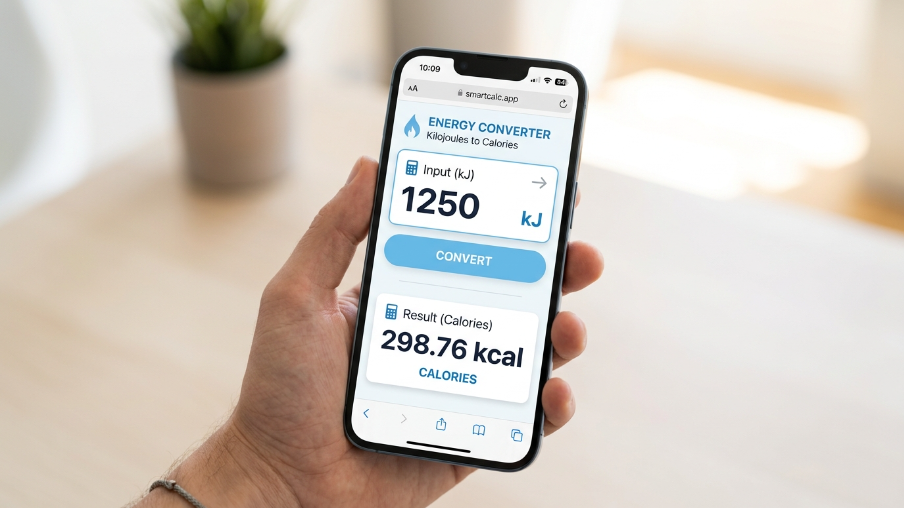
- Energy: 1,250 kJ
Enter 1250 into the calculator, and the result is approximately
- 298.76 calories
The calculation does not depend on the food itself. Whether the number comes from cereal, chocolate, bread, coffee, fruit or a ready-made meal, the same conversion applies.
The Conversion Behind the Result
There is no complicated nutrition formula involved.
One food calorie is equal to 4.184 kilojoules.
So the conversion from kJ to calories is:
Calories = kJ ÷ 4.184
- For example:
800 ÷ 4.184 = 191.20
Therefore:
- 800 kJ = 191.20 calories
You can use the same equation for any kJ amount.
The calculator simply saves you from repeating the calculation.
Quick kJ to Calories Chart
| Kilojoules (kJ) | Calories |
|---|---|
| 50 | 11.95 |
| 100 | 23.90 |
| 150 | 35.85 |
| 200 | 47.80 |
| 250 | 59.75 |
| 300 | 71.70 |
| 400 | 95.60 |
| 500 | 119.50 |
| 600 | 143.40 |
| 700 | 167.30 |
| 750 | 179.25 |
| 800 | 191.20 |
| 900 | 215.10 |
| 1,000 | 239.01 |
| 1,200 | 286.80 |
| 1,500 | 358.51 |
| 1,800 | 430.21 |
| 2,000 | 478.01 |
| 2,500 | 597.51 |
| 3,000 | 717.01 |
| 4,000 | 956.02 |
| 5,000 | 1,195.03 |
Why Does 1,000 kJ Look Like a Lot?
- This is one of the first things people notice when they start reading Australian food labels.
A product may contain 1,000 kJ, while a similar nutrition page might say 239 calories.
The two numbers can look completely unrelated, but they describe home page the same amount of energy.
The reason is simply that a kilojoule and a calorie are different units.
It is similar to measuring distance in kilometers instead of miles. The number changes, but the
Distance does not.
So when you see a four-digit kJ number, donot assume it automatically means an enormous
amount of food energy.
Convert it first.
Why Food Labels in Australia Use kJ
Kilojoules are commonly used for food energy on Australian nutrition labels.
That can be confusing if you normally see calories on nutrition websites, apps or food
databases.
For example, an Australian package might list:
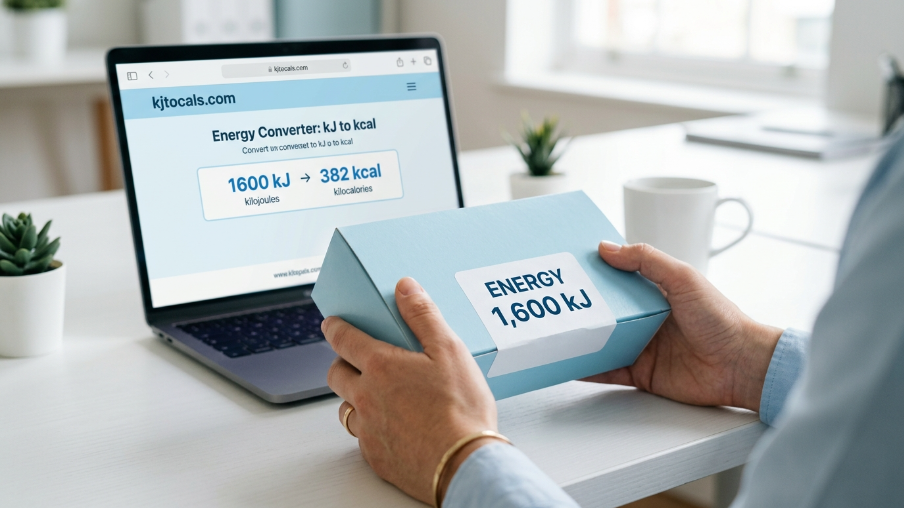
Energy: 1,600 kJ
A calorie-based source would describe that amount as approximately the following:
382.41 calories
Both figures refer to the same energy.
This is particularly useful when comparing Australian products with information from countries
where calories are more commonly displayed for home page.
Check Serving Size Before Comparing
The conversion itself is straightforward. Understanding the label can be a little trickier.
Suppose a snack says:
650 kJ per serving
and the package contains three servings.
One serving is:
650 kJ ≈ 155.35 calories
But eating the complete package would give you the following:
1,950 kJ ≈ 466.06 calories
So the number on the front of your calculator and the amount you actually consume may be
different.
Always look at the serving information next to the energy figure.
Per Serving, Per 100 g or Per Package?
Food labels can present energy in different ways.
Per serving
This tells you how much energy is in the manufacturer’s stated serving.
Per 100 g
This gives you a standard amount and can be helpful when comparing similar products.
Per 100 mL
This is commonly used for drinks and other liquids.
Per package
These numbers should not be mixed when making comparisons.
If one product says 500 kJ per serving and another says 500 kJ per 100 g, that does not mean
The two products contain the same amount of energy per portion.
What Is 100 kJ in Calories?
100 kJ = 23.90 calories
Rounded to a whole number, that is about 24 calories.
Some nearby values are:
200 kJ = 47.80 calories
300 kJ = 71.70 calories
400 kJ = 95.60 calories
500 kJ = 119.50 calories
For casual food-label reading, these are often rounded to 24, 48, 72, 96, and 120 calories.
What Is 500 kJ in Calories?
To convert 500 kJ:
500 ÷ 4.184 = 119.50
So:
500 kJ = 119.50 calories
Rounded to the nearest whole number:
500 kJ ≈ 120 calories
This is a useful reference value when checking smaller snacks and portions.
What Is 1,000 kJ in Calories?
1,000 ÷ 4.184 = 239.01
Therefore:
1,000 kJ = 239.01 calories
For everyday use, you can simply remember:
1,000 kJ ≈ 239 calories
What Is 2,000 kJ in Calories?
2,000 ÷ 4.184 = 478.01
So:
2,000 kJ = 478.01 calories
Rounded:
2,000 kJ ≈ 478 calories
What Is 5,000 kJ in Calories?
5,000 ÷ 4.184 = 1,195.03
Therefore:
5,000 kJ = 1,195.03 calories
Large numbers like this may represent a whole package or several servings, so check the label before assuming the number applies to one portion.
Quick kJ to Calories Reference
100 kJ = 23.90 calories
500 kJ = 119.50 calories
1,000 kJ = 239.01 calories
2,000 kJ = 478.01 calories
5,000 kJ = 1,195.03 calories
Calories to kJ
The conversion can also go in the opposite direction.
If you already have a calorie value and need kilojoules, multiply by 4.184.
kJ = calories × 4.184
For example:
250 × 4.184 = 1,046 kJ
So:
250 calories = 1,046 kJ
Some common values:
| Calories | kJ |
|---|---|
| 50 | 209.20 |
| 100 | 418.40 |
| 150 | 627.60 |
| 200 | 836.80 |
| 250 | 1,046.00 |
| 300 | 1,255.20 |
| 400 | 1,673.60 |
| 500 | 2,092.00 |
| 750 | 3,138.00 |
| 1,000 | 4,184.00 |
kJ and Calories in Everyday Food
You do not need a different formula for different foods.
For example:
350 kJ ≈ 83.65 calories
700 kJ ≈ 167.30 calories
900 kJ ≈ 215.10 calories
1,100 kJ ≈ 262.91 calories
1,600 kJ ≈ 382.41 calories
2,200 kJ ≈ 525.81 calories
These values could come from food, drinks, recipes, or restaurant nutrition information. The
Mathematical conversion remains the same.
What About Drinks?
Drinks can also have their energy listed in kJ.
A bottle might contain 840 kJ.
That works out to 840 ÷ 4.184 = 200.76 calories
So the complete bottle contains about 201 calories, assuming the 840 kJ figure refers to the
entire bottle.
If the label says 840 kJ per serving and the bottle contains two servings, the total would be
different.
This is why checking the serving information matters just as much as converting the number.

What About Restaurant Nutrition Information?
Restaurants may publish nutrition details using either calories or kilojoules, depending on the
country and source.
If you are comparing menus from different regions, you may need to switch one value into the
other.
For example:
1,450 kJ ≈ 346.56 calories
This makes it easier to compare two menu items when their nutrition information uses different
units.
Can I Use the Converter for Recipes?
- Recipes sometimes come from websites or cookbooks that use a different measurement system
from the one you normally use.
If the recipe gives energy in kJ and you want calories, enter the number into the calculator.
Just make sure the serving size is the same when comparing two recipes.
A recipe might list energy per portion, while another could show it for the complete recipe.
The conversion won’t fix that difference. You need to check the recipe details first.
Why Are Some Results Rounded?
You may notice that your calculator gives 239.01 calories, while a food website says 239
calories.
There is no real disagreement.
The second figure has simply been rounded.
For example:
1,000 ÷ 4.184 = 239.0057…
A website may display the result as
239 calories
Another may display:
239.01 calories
Both come from the same conversion.
For normal food-label comparisons, rounding to a whole calorie is usually enough.
Understanding Daily Energy Numbers
You may also come across kJ and calories when reading about daily energy intake.
It is important not to assume that one daily figure is suitable for everybody.
Energy requirements differ between people. Factors such as age, body size, physical activity
and lifestyle can affect how much energy a person needs.
A conversion calculator can tell you what a number means, but it cannot determine your
personal nutritional requirements.
For individual dietary advice, speak with a qualified healthcare or nutrition professional.
More Common kJ Values
| kJ | Calories |
|---|---|
| 75 | 17.93 |
| 125 | 29.88 |
| 175 | 41.83 |
| 225 | 53.78 |
| 350 | 83.65 |
| 450 | 107.55 |
| 550 | 131.45 |
| 650 | 155.35 |
| 850 | 203.15 |
| 950 | 227.05 |
| 1,100 | 262.91 |
| 1,300 | 310.71 |
| 1,700 | 406.31 |
| 2,200 | 525.81 |
| 2,700 | 645.32 |
| 3,500 | 836.52 |
These are calculated using 1 calorie = 4.184 kJ.
Frequently Asked Questions
1,000 kJ = approximately 239.01 calories.
2,000 kJ = approximately 478.01 calories.
Divide the kJ value by 4.184.
Multiply the calorie value by 4.184.
Kilojoules are commonly used to show food energy on Australian nutrition labels.
No. Both measure energy, but they are different units.
No. The same conversion factor applies to every energy value.
Usually because one result has been rounded differently.
Either can tell you about energy. The important thing is to understand which unit is being used and what quantity the number applies to.
Yes. A listed energy value may apply to one serving rather than the entire product.