
Daily kJ Intake: How Many Kilojoules Do You Need?
If you have ever looked at an Australian food label and wondered,
- “How many kilojoules should I eat in a day?”You are not alone.
Food packaging in Australia usually lists energy in kilojoules (kJ). You may see numbers such as 500 kJ, 1,000 kJ, 2,000 kJ or even 10,000 kJ and wonder what they actually mean for your daily diet.
- The important thing to understand is that there is no single daily kJ intake that is right for every person. Your energy needs depend on several factors, including your age, sex, body size and physical activity. Your requirements can also change as your lifestyle changes.
For example:
someone who spends most of the day sitting may need considerably less energy than someone who walks frequently, exercises regularly or has a physically demanding job.
Australian nutrition guidance uses estimated energy requirements because individual energy needs can vary substantially, even among people of a similar age and body size.
This guide explains what daily kJ intake means, how many kilojoules people may need, how kJ compares with calories, how to read Australian food labels and how to make sense of your own daily energy needs.
What Is a Kilojoule?
- A kilojoule (kJ) is a unit used to measure energy.
When you eat and drink, your body gets energy from nutrients such as carbohydrates, protein and fat. Your body then uses that energy to keep essential processes working and to power physical activity.
You need energy for things you may not even think about, including:
- Breathing
- Keeping your heart beating
- Maintaining body temperature
- Supporting brain function
- Digesting food
- Moving your body
- Repairing and maintaining tissues
- Exercising and performing everyday activities
In Australia and New Zealand, kilojoules are the standard unit used for dietary energy. One kilocalorie is equal to approximately 4.18 kilojoules.
That means kJ and calories are simply two different ways of expressing food energy.
kJ and calories conversion
The basic conversion is:
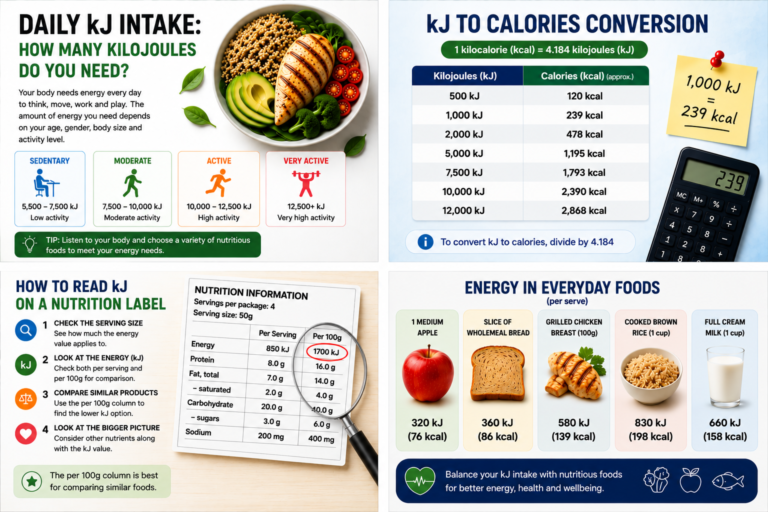
1 kcal = 4.184 kJ
To convert kilojoules to calories:
Calories = kJ ÷ 4.184
For example:
1,000 kJ ÷ 4.184 = 239 kcal
So, 1,000 kJ is approximately 239 calories.
This conversion can be useful if you are used to thinking in calories but live in Australia and mainly see kilojoules on food packaging.
How Many kJ Do You Need Per Day?
This is where things become more personal.
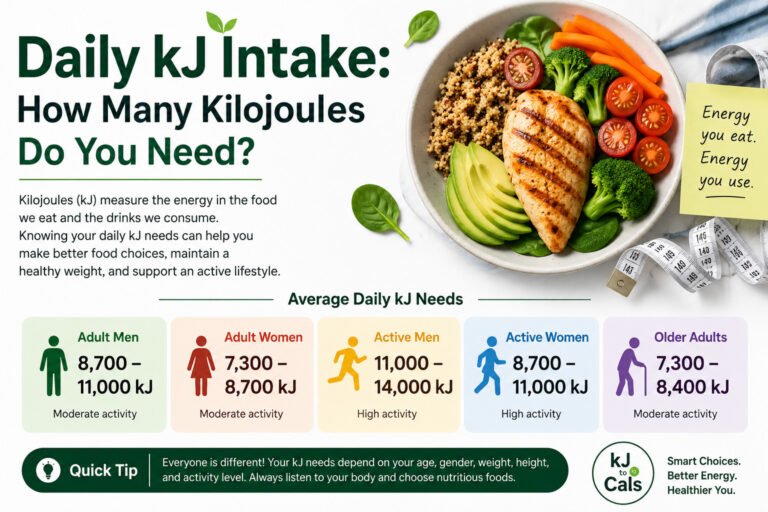
There is no universal number that every adult should eat each day. Australian Nutrient Reference Values explain that energy requirements differ according to factors such as age, sex, body size and physical activity level.
As a broad reference, Australian dietary information has reported average energy intakes around 10,000 kJ per day for adult men and 7,500 kJ per day for adult women. These figures are population averages, not recommended targets for every individual.
It is therefore better to treat these numbers as a starting point for understanding energy intake rather than as a rule.
For example, an active person may need considerably more energy than a sedentary person. Likewise, a smaller person may need less energy than a larger person.
This is where things become more personal.
There is no universal number that every adult should eat each day. Australian Nutrient Reference Values explain that energy requirements differ according to factors such as age, sex, body size and physical activity level.
As a broad reference, Australian dietary information has reported average energy intakes around 10,000 kJ per day for adult men and 7,500 kJ per day for adult women. These figures are population averages, not recommended targets for every individual.
It is therefore better to treat these numbers as a starting point for understanding energy intake rather than as a rule.
For example:
An active person may need considerably more energy than a sedentary person. Likewise, a smaller person may need less energy than a larger person.
Imagine two people who are both 30 years old.
One works at a desk, drives to work and rarely exercises.
The other works on their feet, walks several kilometres during the day and trains at the gym several times a week.
It would not make sense to assume that both people require exactly the same amount of energy.
This is one reason Australian guidance uses estimated energy requirements rather than suggesting one fixed daily amount for everyone. Individual variation can be quite large.
What Determines Your Daily kJ Requirement?
Your daily energy needs are influenced by several important factors.
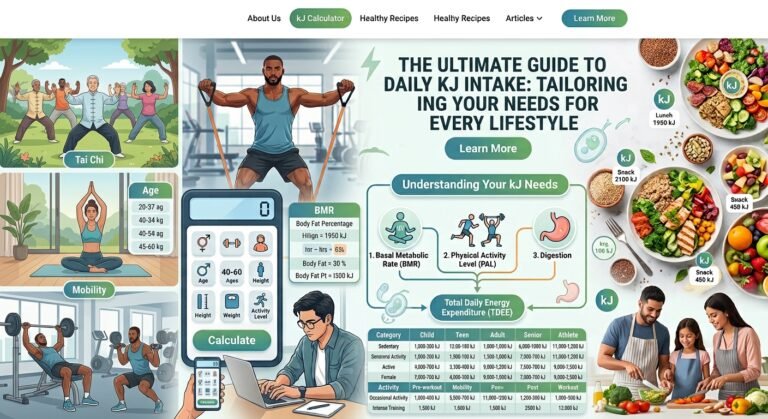
- Age
Age can affect energy requirements.
Children and teenagers need energy not only for daily activities but also for growth and development. Adults generally need energy to maintain body functions and support their normal lifestyle.
Energy requirements can change again as people get older, particularly when body composition and physical activity change.
This is why a daily kJ intake that worked for you several years ago may not necessarily be appropriate now.
- Body Size
Body size is another important factor.
Your height and body weight influence the amount of energy your body uses. In general, a larger body requires more energy to support basic functions and movement than a smaller body.
However, body size should never be considered on its own. Two people with a similar weight can have different energy needs because their activity levels, body composition and other characteristics may differ.
- Physical Activity
Physical activity can make a significant difference to your daily energy expenditure.
Your body uses energy when you:
- Walk
- Run
- Cycle
- Swim
- Exercise
- Play sports
- Work in a physically active job
- Perform household tasks
Someone who is highly active may therefore require considerably more kJ than someone who is mostly sedentary.
Australian energy requirement estimates use different physical activity levels to reflect these differences.
. Sex
Energy requirements can also differ between males and females.
This is partly related to average differences in body size, body composition and energy expenditure. However, sex by itself does not tell you exactly how many kilojoules you personally need.
Your individual circumstances still matter.
. Pregnancy and Breastfeeding
Pregnancy and breastfeeding can change energy requirements.
- Australian Nutrient Reference Values provide additional energy requirements during the later stages of pregnancy and during lactation. For example, the reference values list an additional 1.4 MJ per day during the second trimester and 1.9 MJ per day during the third trimester, while lactation has additional requirements as well.
Because pregnancy and breastfeeding involve individual nutritional needs, general online numbers should not replace advice from a qualified healthcare professional.
How Many Calories Are in 1,000 kJ?
This is one of the most common kJ questions.
The calculation is simple:
- 1,000 kJ ÷ 4.184 = 239 kcal
Therefore:
- 1,000 kJ ≈ 239 calories
Here are some other common conversions:
| Kilojoules | Approximate calories |
|---|---|
| 500 kJ | 120 kcal |
| 1,000 kJ | 239 kcal |
| 1,500 kJ | 359 kcal |
| 2,000 kJ | 478 kcal |
| 3,000 kJ | 717 kcal |
| 4,000 kJ | 956 kcal |
| 5,000 kJ | 1,195 kcal |
| 6,000 kJ | 1,434 kcal |
| 7,500 kJ | 1,793 kcal |
| 8,000 kJ | 1,912 kcal |
| 9,000 kJ | 2,151 kcal |
| 10,000 kJ | 2,390 kcal |
| 12,000 kJ | 2,868 kcal |
These are energy conversions, not recommended daily intake levels.
Is 8,000 kJ a Day Too Much?
Not necessarily.
Whether 8,000 kJ is appropriate depends on the individual.
For someone with relatively low energy requirements, 8,000 kJ could be a substantial amount. For a taller or highly active person, the same amount may be much closer to their daily needs.
It is therefore not useful to label a particular number as automatically “too much” without considering the person behind it.
The Australian Nutrient Reference Values show that estimated energy requirements can vary considerably depending on body size and physical activity level.
Instead of asking whether 8,000 kJ is good or bad, ask whether it is appropriate for your own energy needs and goals.
Is 10,000 kJ a Day Normal?
You will often see 10,000 kJ used as a convenient reference number in Australia.
It is approximately equal to:
- 10,000 kJ ÷ 4.184 = 2,390 kcal
But 10,000 kJ should not be interpreted as a universal daily requirement.
Some people may naturally need around this amount, while others may need significantly less or more.
Australian energy guidance specifically warns against applying an average energy requirement to individuals whose age, body size, sex or activity level differs from the group for which the average was calculated.
How to Read kJ on a Food Label
Understanding the nutrition information panel can make daily kJ tracking much easier.
Australian packaged foods generally provide nutrition information per serving and per 100 g, or per 100 mL for liquids. The panel can include energy as well as protein, fat, saturated fat, carbohydrate, sugars and sodium.
For example:
- you might see:
| Nutrition information | Per serving | Per 100 g |
|---|---|---|
| Energy | 850 kJ | 1,700 kJ |
| Protein | 8 g | 16 g |
| Fat | 7 g | 14 g |
| Carbohydrate | 20 g | 40 g |
- The per-serving value tells you how much energy is in the listed serving.
- The per-100-g value makes it easier to compare similar products.
Why the serving size matters
Suppose a packet contains two servings and the label says:
- 850 kJ per serving
If you eat the entire packet, you have consumed:
- 850 × 2 = 1,700 kJ
This is a simple calculation, but it is easy to overlook when you are quickly reading a label.
Always check whether you are eating one serving, half a serving or the entire package.
Per Serving vs Per 100 g: Which Should You Use?
Both numbers have a purpose.
Use per serving when you want to estimate how much energy you will actually consume from the amount you plan to eat.
Use per 100 g when comparing similar products.
For example:
- Product A: 1,400 kJ per 100 g
- Product B: 1,800 kJ per 100 g
Product A has less energy per 100 g.
However, this does not automatically make it the healthier option. Energy is only one part of nutrition. You should also consider protein, fibre, saturated fat, sodium, added ingredients and the overall nutritional quality of the food.
Does Your Daily kJ Intake Affect Weight?
Energy intake is one part of the picture when it comes to body weight.
Your body constantly uses energy. Food and drinks provide energy. Over time, the relationship between energy consumed and energy used can influence changes in body weight.
If someone consistently consumes more energy than their body uses, the excess energy can contribute to weight gain. If energy intake remains below energy expenditure over time, weight loss can occur.
However, this does not mean that one high-kJ meal automatically causes weight gain.
Your body weight is influenced by longer-term patterns, and energy expenditure can vary from day to day.
The Australian Government’s daily energy calculator explains that energy requirements can change according to factors including age, sex, body size and physical activity.
Daily kJ Intake for Weight Loss
If you are trying to lose weight, you may naturally become more interested in kilojoules.
Understanding the energy content of food can be useful because it gives you a clearer picture of how much energy you are consuming.
But weight loss does not mean choosing the lowest possible kJ intake.
Your body still needs enough energy and nutrients to support normal functions and everyday life. A very restrictive diet can also be difficult to maintain.
A more practical approach is to understand your estimated energy requirement and make sensible changes to your overall eating pattern.
The Australian Eat for Health program provides a daily energy requirements calculator that takes information such as age, weight and physical activity into account.
If you have a medical condition, are pregnant or breastfeeding or have specific nutritional requirements, personalised guidance from an appropriately qualified health professional is preferable to following a generic calorie or kJ target.
Does Exercise Increase Your kJ Needs?
Yes, physical activity uses energy.
The amount varies depending on the type, duration and intensity of the activity.
For example:
- A person who spends an hour walking may use a different amount of energy from someone who spends an hour running. A person with a physically demanding occupation may also use more energy during the day than someone working at a desk.
- This is why your daily energy needs are not necessarily identical every day.
- A particularly active day may require more energy than a day when you spend most of your time resting.
- Australian energy reference values account for different physical activity levels when estimating energy requirements.
What Should You Eat With Your Daily kJ?
Knowing your energy intake is useful, but food quality matters too.
Two meals can contain a similar number of kilojoules while providing very different amounts of protein, fibre, vitamins and minerals.
Australian dietary guidance encourages a varied eating pattern built around the five food groups, including vegetables and legumes, fruit, grain foods, lean meat and alternatives, and milk, yoghurt, cheese and alternatives.
A balanced approach can include:
- Plenty of vegetables and legumes
- Fruit
- Wholegrain or high-fibre grain foods
- Lean sources of protein
- Fish, eggs, nuts and seeds
- Milk, yoghurt, cheese or suitable alternatives
- Mostly unsaturated sources of fat
The aim is not simply to hit a kJ number. Your food should also provide the nutrients your body needs.
A Practical Way to Manage Daily kJ Intake
You do not necessarily need to calculate every single kilojoule forever.
Instead, understanding a few basic habits can make nutrition labels much easier
- Check the serving size
Before looking at the kJ number, find out what the manufacturer considers one serving.
- Look at energy per serving
This tells you approximately how much energy you will consume if you eat that serving.
- Compare products using per 100 g
When choosing between similar products, the per-100-g figure provides a fairer comparison.
- Consider the whole nutrition panel
Do not judge food based on kJ alone. Look at protein, fibre, saturated fat, sugars and sodium as appropriate.
- Think about your entire day
One food does not determine your overall diet.
A high-energy food can sometimes fit into a balanced eating pattern, just as a low-energy food is not automatically nutritious.
Common Daily kJ Amounts and Their Calorie Equivalents
- If you are used to calories, this table can help you quickly understand common daily energy figures:
| Daily kJ | Approx. kcal |
|---|---|
| 5,000 kJ | 1,195 kcal |
| 6,000 kJ | 1,434 kcal |
| 7,000 kJ | 1,673 kcal |
| 7,500 kJ | 1,793 kcal |
| 8,000 kJ | 1,912 kcal |
| 9,000 kJ | 2,151 kcal |
| 10,000 kJ | 2,390 kcal |
| 11,000 kJ | 2,629 kcal |
| 12,000 kJ | 2,868 kcal |
| 14,000 kJ | 3,346 kcal |
Again, these figures simply convert energy units. They are not personalised recommendations.
What Is a Good Daily kJ Intake?
A “good” daily kJ intake is not necessarily the same for everyone.
A better question is:
- What amount of energy is appropriate for my body, activity level and goals?
For healthy adults, estimated energy requirements can be used as a guide. The Australian Government provides a calculator designed to estimate daily energy needs based on personal information.
It is also worth remembering that these calculations are estimates. The official Nutrient Reference Values note that individual energy requirements can vary considerably, even between people who appear similar.
Can You Eat Too Few Kilojoules?
Yes.
Your body requires energy for basic functions as well as movement and daily activities.
Eating too little energy for an extended period may make it difficult to meet your nutritional needs and can affect how you feel and function.
This is particularly important for children, teenagers, pregnant people, breastfeeding mothers and anyone with a medical or nutritional condition.
If you are considering a significant reduction in your food intake, professional dietary advice can help you choose an approach that is appropriate and nutritionally adequate.
Why Your kJ Needs May Change Over Time
Your daily energy requirement is not necessarily fixed for life.
It can change if:
- Your body weight changes
- You become more or less active
- Your work changes
- You start or stop exercising
- You age
- Your lifestyle changes
- You become pregnant or start breastfeeding
This is another reason not to become overly attached to one particular kJ number.
A target that was suitable during a very active period may not make sense during a more sedentary period and vice versa.
Frequently Asked Questions About Daily kJ Intake
How many kJ should an adult eat per day?
There is no single amount that applies to every adult. Energy requirements vary with age, sex, body size and physical activity. Australian reference information provides estimated requirements rather than one universal target.
How many calories are in 1,000 kJ?
1,000 kJ is approximately 239 kcal. The calculation is 1,000 ÷ 4.184.
How many calories are in 10,000 kJ?
10,000 kJ is approximately 2,390 kcal. This is an energy conversion and does not mean that everyone should consume 10,000 kJ per day.
Is 7,500 kJ enough for a day?
It depends on the individual. A person’s energy requirement is affected by factors such as body size, age,sex and activity level.
Is 8,000 kJ too much?
Not automatically. For some people it may be close to their needs, while others may need more or less.
Is 10,000 kJ a standard daily requirement in Australia?
It is often used as a convenient reference figure, but it is not a universal requirement. Individual energy needs vary substantially.
Does exercise increase the amount of kJ I need?
Physical activity increases energy expenditure, so active people can have higher energy requirements than people with low activity levels.
Should I count every kilojoule I eat?
Not necessarily. Tracking kJ can be useful for some people, particularly when learning about portion sizes and energy content, but a healthy diet involves more than simply counting energy.
Why do Australian food labels use kJ?
Kilojoules are the standard unit used to express dietary energy in Australia. Nutrition information panels can list energy in kilojoules or in both kilojoules and kilocalories.
What is the difference between kJ and calories?
Both measure energy. The main difference is the unit being used. 1 kcal = 4.184 kJ Therefore, to convert kJ to kcal, divide the kJ value by 4.184