
kJ Calculator Guide: How to Actually Read the Energy on a Food Label
The first time I picked up a muesli bar in an Australian supermarket and saw “480 kJ” on the back I had no idea whether that was a light snack or half my lunch. If you have only ever counted Calories kilojoules can feel like a foreign language.
They are not though. It is one simple division sum. After a while you may not even need a calculator.
So what is a kJ calculator?
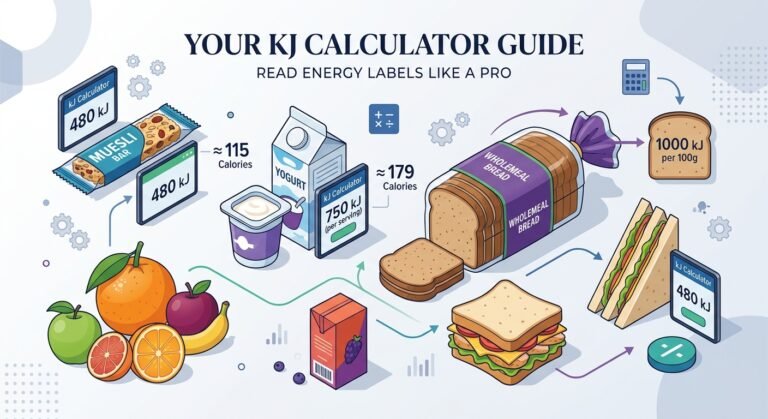
Nothing fancy. You enter a kilojoule figure and it gives you the Calories. That 480 kJ muesli bar comes to roughly 115 Calories.
A calculator becomes useful when the numbers get less convenient. You may have an American recipe that lists Calories while your food packet shows kJ. You may also be comparing two products with different serving sizes. Another common situation is eating more than the serving size shown on the package.
What kJ actually means
- Kilojoule is a unit of energy. A Calorie is also a unit of energy. Your body uses energy for everything it does throughout the day.
- Australian food labels usually show energy in kJ. Some labels also show Calories while others only list kilojoules.
- When a label says “Energy: 800 kJ per serving” it means that one serving provides 800 kJ of energy.
- The serving size is important. Most nutrition panels have a per serving column and a per 100 g column. Choosing the wrong one can give you an incorrect idea of how much energy you are actually eating.
Doing the conversion
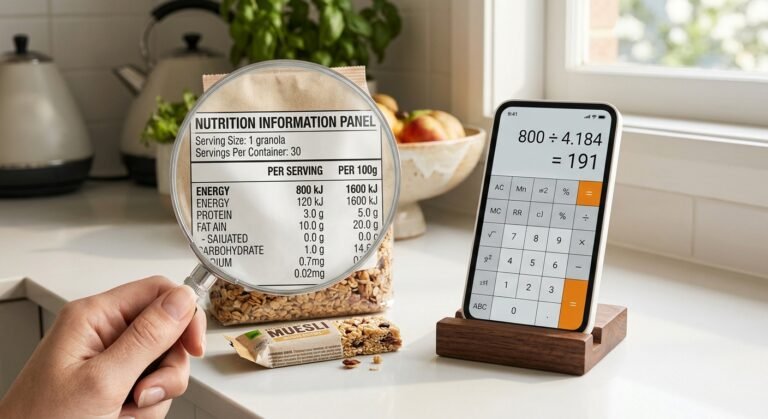
First find the Energy row on the nutrition panel. Imagine it says 750 kJ per serving.
Now check the serving size. If you ate one serving you can convert the number directly.
- 750 ÷ 4.184 = about 179 Calories
If you ate half the serving then you would simply take half of the energy.
The method is simple once you know the conversion factor.
The two formulas
- Calories = kJ ÷ 4.184
- kJ = Calories × 4.184
Here are some useful numbers to remember:
- 300 kJ ≈ 72 Calories
- 500 kJ ≈ 120 Calories
- 1,000 kJ ≈ 239 Calories
- 2,000 kJ ≈ 478 Calories
For a quick estimate you can divide kJ by 4. The result will be slightly higher than the exact conversion. For accurate calculations use 4.184.
To convert Calories back into kilojoules multiply by 4.184.
For example:
- 250 Calories × 4.184 = 1,046 kJ
Per serving vs per 100 g
The per serving figure tells you how much energy is in the serving defined on the package. The per 100 g figure gives you a standard measurement that makes product comparisons easier.
Imagine a cereal lists 620 kJ per 40 g serving.
That works out to 15.5 kJ per gram.
If you eat 60 g instead the amount becomes:
- 620 × 60 ÷ 40 = 930 kJ
The number on the packet has not changed. Your portion has.
For comparing products the per 100 g value is usually easier to use.
For example:
- Product A = 750 kJ per 100 g
- Product B = 980 kJ per 100 g
Product B provides more energy for the same weight.
Drinks often use per 100 mL instead of per 100 g.
Your actual portion
You can calculate the energy in almost any portion with this formula:
- kJ per 100 g × grams eaten ÷ 100
Suppose a food contains 1,200 kJ per 100 g and you eat 75 g.
- 1,200 × 75 ÷ 100 = 900 kJ
That is roughly 215 Calories.
Another example is a food containing 800 kJ per 100 g. If you eat 50 g:
- 800 × 50 ÷ 100 = 400 kJ
The same method works for different foods and portion sizes.
A table to eye ball
| Kilojoules | Approx. Calories |
|---|---|
| 100 kJ | 24 |
| 200 kJ | 48 |
| 300 kJ | 72 |
| 400 kJ | 96 |
| 500 kJ | 120 |
| 600 kJ | 143 |
| 750 kJ | 179 |
| 800 kJ | 191 |
| 1,000 kJ | 239 |
| 1,500 kJ | 359 |
| 2,000 kJ | 478 |
These figures are rounded. A calculator using the full 4.184 conversion factor may show a decimal result.
Where people go wrong
- Not checking the number of servings
A packet may contain several servings even when it looks like something you could finish in one sitting.
- Using the wrong column
Nutrition labels often place per serving and per 100 g values close together. Always check which figure you are using.
- Ignoring your actual portion
If the label gives values for 50 g but you eat 80 g the energy you consume will be higher than the listed serving value.
- Mixing up kJ and Calories
Kilojoules and Calories measure energy using different units. They are not interchangeable numbers. One Calorie is approximately 4.184 kJ.
- Looking only at energy
The kJ figure tells you about energy. It does not describe every part of a food’s nutritional value. Other information on the label can also be useful.
kJ vs Calories briefly
- kJ and Calories are different units used to describe energy.
- A label showing 840 kJ is showing roughly 201 Calories.
- Neither number is more real than the other. They simply use different units.
If you regularly read Australian food labels two useful numbers to remember are:
- 500 kJ ≈ 120 Calories
- 2,000 kJ ≈ 478 Calories
These quick reference points can make everyday label reading easier.
One thing worth remembering
A higher kJ number does not automatically tell you whether a food is good or bad.
Some nutritious foods can be relatively energy dense. Nuts and oils are common examples. On the other hand a drink can have a moderate energy value while still being easy to consume in a large amount.
Portion size matters too.
A food containing 1,000 kJ per 100 g would provide around 500 kJ if you ate 50 g.
That is why it makes sense to look at the energy figure together with the serving size and the rest of the nutrition panel.
FAQs
What's a kJ calculator for?
A kJ calculator helps convert kilojoules into Calories and Calories into kilojoules. It can also help you work out the energy in a particular portion.
How many Calories are in 500 kJ?
500 kJ is approximately 119.5 Calories. For everyday use you can round this to about 120 Calories.
How many Calories are in 1,000 kJ?
1,000 kJ is approximately 239 Calories.
What is the kJ to Calories formula?
The formula is:
Calories = kJ ÷ 4.184
What is the Calories to kJ formula?
Multiply Calories by 4.184.
For example:
200 Calories × 4.184 = 836.8 kJ
Should I use per serving or per 100 g?
Use the per serving figure when you are eating the exact serving shown on the label. Use the per 100 g figure when comparing products or calculating the energy in your own portion.
Are kJ and Calories the same?
They both measure energy but they are different units. One Calorie is approximately 4.184 kJ.
Does the kJ number tell me if something is healthy?
No. The kJ value tells you how much energy the food provides. It does not describe the complete nutritional quality of the food.