
500 kJ to Calories: Quick Conversion Guide
Seeing 500 kJ on a food label and wondering how many calories that actually means? You are not alone. Australian food labels usually show energy in kilojoules, while many people are more familiar with calories.
The good news is that the conversion is simple.
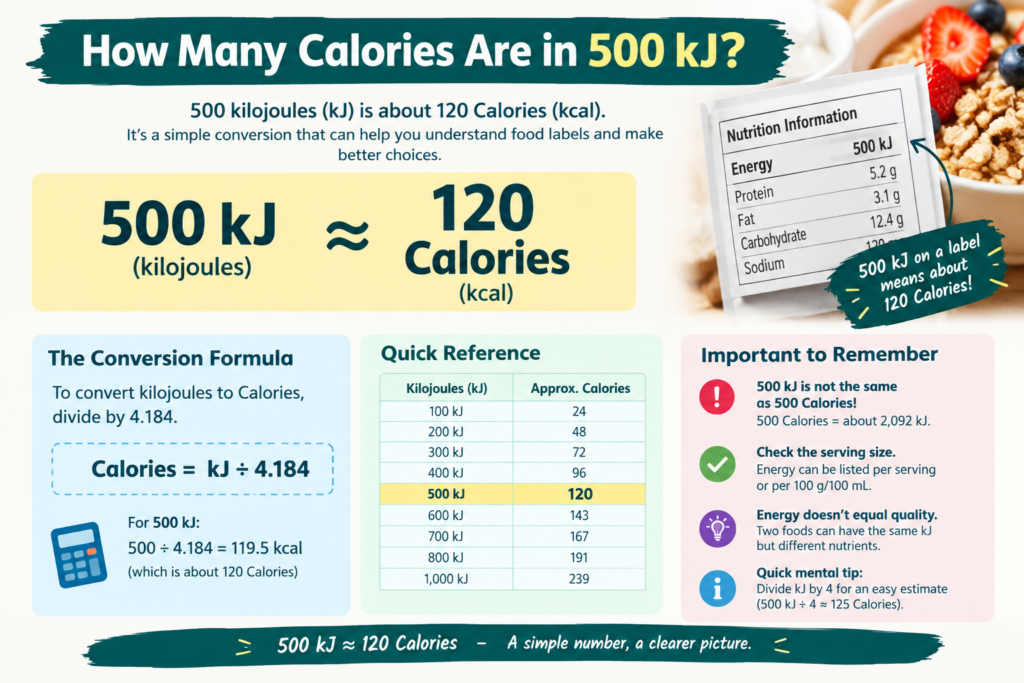
- 500 kJ is about 120 Calories (kcal).
That number can make it much easier to understand the energy in a snack, drink, breakfast item or part of a meal.
How Many Calories Are in 500 kJ?
- 500 kilojoules = approximately 119.5 Calories.
For everyday use, you can round this to:
- 500 kJ ≈ 120 Calories
Here, “Calories” with a capital C means kilocalories (kcal), which is the calorie unit normally used on food labels and nutrition information.
| Energy | Calories |
|---|---|
| 500 kJ | 119.5 kcal |
| Rounded value | 120 Calories |
So, if a packet says it contains 500 kJ, you can think of it as having roughly 120 Calories of energy.
The Simple 500 kJ to Calories Formula
To convert kilojoules into Calories, divide the kJ value by 4.184.
Formula:
- Calories = kJ ÷ 4.184
For 500 kJ:
- 500 ÷ 4.184 = 119.5 kcal
After rounding:
- 500 kJ = about 120 Calories
You do not need to work this out every time. Once you know that 500 kJ is close to 120 Calories, it becomes a useful reference point when reading food labels.
Why 500 kJ Can Be Useful to Know
A single energy number does not tell you whether a food is healthy or unhealthy. It simply tells you how much energy it provides.
Knowing the conversion can still be useful when comparing foods.
- For example:
you might see one snack listed as 450 kJ and another listed as 600 kJ. Converting both to Calories gives you a clearer comparison if you normally track your food intake in kcal.
This is especially helpful when you are used to calorie based nutrition information but live somewhere that uses kilojoules on food packaging.
500 kJ to Calories on Australian Food Labels
In Australia, packaged foods commonly show energy in kilojoules. You may see values listed under a nutrition information panel as either:
- Per serving
- Per 100 g
- Per 100 mL
This difference matters.
If a label says 500 kJ per serving, that serving provides about 120 Calories.
But if it says 500 kJ per 100 g, the whole package may contain more than 120 Calories if the package is larger than 100 g.
- For example:
imagine a food has 500 kJ per 100 g and the package contains 300 g. The complete package would contain three times the energy:
- 500 × 3 = 1,500 kJ
That equals about 359 Calories.
So always check whether the number refers to the serving or the full product.
Quick 500 kJ Conversion
Here is the key number to remember:
- 500 kJ = 119.5 kcal = approximately 120 Calories
For quick mental calculations, you can use a simple shortcut:
- kJ ÷ 4.2 ≈ Calories
Using that shortcut:
- 500 ÷ 4.2 ≈ 119 Calories
It is not as precise as dividing by 4.184, but it is close enough for a quick estimate.
Common Energy Values Around 500 kJ
If you are reading different food labels, these nearby values can help you get a feel for the conversion.
| Kilojoules | Approx. Calories |
|---|---|
| 100 kJ | 24 Calories |
| 200 kJ | 48 Calories |
| 300 kJ | 72 Calories |
| 400 kJ | 96 Calories |
| 500 kJ | 120 Calories |
| 600 kJ | 143 Calories |
| 700 kJ | 167 Calories |
| 800 kJ | 191 Calories |
| 900 kJ | 215 Calories |
| 1,000 kJ | 239 Calories |
- These figures are rounded, so small differences may appear depending on the conversion method or rounding used on a food label.
Is 500 kJ a Lot of Energy?
It depends on what you are eating and how much of it you consume.
For one small snack, 500 kJ may represent a noticeable amount of energy. For a full meal, 500 kJ would generally be a much smaller amount.
It is better to look at the serving size and the rest of the meal rather than judging a food from one energy number.
For example:
- A food that provides 500 kJ per serving gives you about 120 Calories. If you eat two servings, the amount doubles:
- 500 kJ × 2 = 1,000 kJ
And:
- 1,000 kJ ≈ 239 Calories
This is why serving size is one of the first things worth checking on a nutrition label.
500 kJ in Everyday Foods
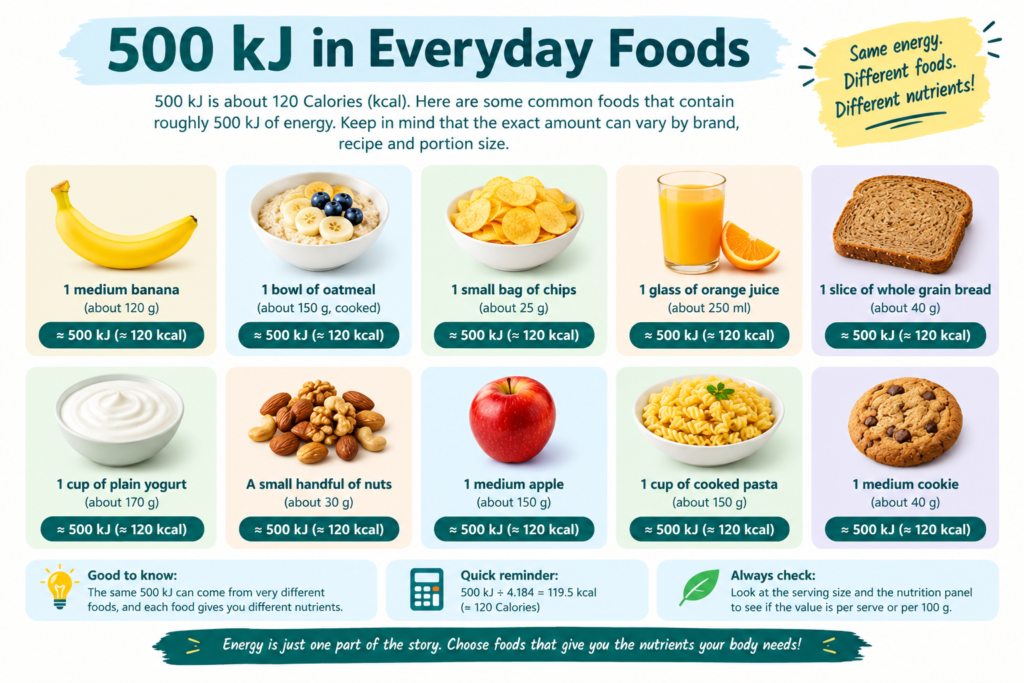
The exact energy content of food varies widely because recipes, ingredients, brands and portion sizes are different.
Around 500 kJ or 120 Calories, could be found in a relatively small portion of some foods. A snack with this amount of energy might include a combination of carbohydrates, protein, fat or other nutrients.
- The important point is that 500 kJ describes energy, not food quality.
Two foods can both contain 500 kJ while having very different amounts of protein, fibre, sugar, fat, vitamins and minerals.
That is why calories or kilojoules are only one part of the nutrition picture.
How to Convert Calories Back to 500 kJ
The conversion works in both directions.
If you have a calorie value and want to convert it into kilojoules, multiply Calories by 4.184.
For example:
- 120 Calories × 4.184 = 502.1 kJ
Because 120 Calories is a rounded version of 119.5 Calories, the result is slightly above 500 kJ.
Using the exact value:
- 119.5 × 4.184 ≈ 500 kJ
This shows why rounded nutrition numbers may not match perfectly when you convert them back.
500 kJ vs 500 Calories
These two numbers are very different.
- 500 kJ is about 120 Calories.
But:
- 500 Calories is about 2,092 kJ.
So if you see 500 kJ on a food label, do not mistake it for 500 Calories.
| Energy | Approximate Equivalent |
|---|---|
| 500 kJ | 120 Calories |
| 500 Calories | 2,092 kJ |
- This is one of the most important things to remember when switching between the two units.
Why Kilojoules and Calories Both Exist
- Kilojoules and Calories are both units used to describe energy.
A kilojoule is part of the metric system. Calories are commonly used in nutrition discussions and food tracking.
- The two units measure the same basic thing: energy.
The difference is simply the unit used to express that energy.
The standard relationship is:
- 1 Calorie = 4.184 kJ
And:
- 1 kJ = 0.239 Calories
Once you know this relationship, converting between the two is straightforward.
A Quick Way to Estimate kJ as Calories
If you are checking several labels and do not need an exact number, there is an easy shortcut.
Divide the kilojoule number by about 4.
For example:
- 500 kJ ÷ 4 ≈ 125 Calories
The more accurate result is about 120 Calories, but the shortcut gives you a quick estimate.
For more precise calculations, use:
- kJ ÷ 4.184
This gives the calorie value more accurately.
Does 500 kJ Equal 120 Calories Exactly?
Not quite.
The exact conversion is:
- 500 kJ = 119.502 Calories
That is why we normally say about 120 Calories.
Food labels themselves may use rounding, so the number you calculate may not always be identical to a value printed on packaging.
A difference of one or two Calories can simply come from rounding.
How 500 kJ Fits Into Daily Energy Intake
- Your body needs energy throughout the day for basic functions and physical activity.
- The amount of energy a person needs varies based on factors such as age, body size, activity level and other individual circumstances.
- Because of this, 500 kJ does not have the same meaning for everyone.
- For one person, 500 kJ might be part of breakfast. For another, it could be a snack or part of a larger meal.
- Rather than treating 500 kJ as a fixed amount that everyone should eat, it is more useful to understand what the number means and compare it with the rest of your daily food intake.
Reading a Label With 500 kJ
Suppose you pick up a packaged snack and see:
Energy: 500 kJ per serving
- That means one listed serving provides about 120 Calories.
If the packet contains four servings and you eat the entire packet:
- 500 × 4 = 2,000 kJ
That equals approximately:
- 478 Calories
So the serving information can make a big difference.
Always check both the serving size and servings per package before comparing products.
Frequently Asked Questions
How many Calories are in 500 kJ?
500 kJ is approximately 120 Calories (kcal). The exact conversion is about 119.5 kcal.
What is the formula for converting 500 kJ to Calories?
Divide kilojoules by 4.184.
500 ÷ 4.184 = 119.5 Calories
Is 500 kJ equal to 500 Calories?
No. They are different units. 500 kJ is about 120 Calories, while 500 Calories is about 2,092 kJ.
How many Calories are in 500 kJ of food?
If the food provides 500 kJ of energy, that is approximately 120 Calories. The amount of food needed to provide 500 kJ depends on the food and its serving size.
How many kJ are in 120 Calories?
120 Calories equals about 502 kJ. The small difference from 500 kJ comes from rounding.
Is 500 kJ per serving or per 100 g?
It depends on the label. Nutrition panels may list energy per serving and per 100 g or 100 mL. Always check the heading above the number.
Can I use 500 kJ as a quick calorie reference?
Yes. Remembering 500 kJ ≈ 120 Calories can make Australian food labels easier to understand.