
Australian Food Energy Guide: kJ, Calories and Food Labels Explained
If you have ever picked up a food packet in Australia and wondered what 1,200 kJ actually means, you are not the only one.
Australian food labels usually show energy in kilojoules (kJ). People who are more familiar with calories may see a number such as 1,500 kJ and have no immediate idea how it compares with the calorie figures they see online.
The good news is that the difference is only a matter of measurement.
Kilojoules and calories are both units used to describe energy.
Once you know how they relate to each other, Australian food labels become much easier to read.
This guide explains what kJ means, how calories relate to kilojoules, how to read the Nutrition Information Panel, why serving size matters, and how to compare foods without getting confused by the numbers.
What Does kJ Mean on Australian Food Labels?
- kJ stands for kilojoule.
A kilojoule is a unit used to measure energy. In Australia, food and drink energy is commonly expressed in kilojoules. Australian health guidance also describes kilojoules as the measure used for the energy we get from food and drinks.
When you see something like:
- Energy: 850 kJ
the number tells you how much energy is provided by the stated amount of food.
The important part is understanding what amount of food the number refers to.
It might be:
- Per serving
Per 100 g
Per 100 mL
Or in some cases, another stated quantity
That distinction can completely change how you interpret the figure.
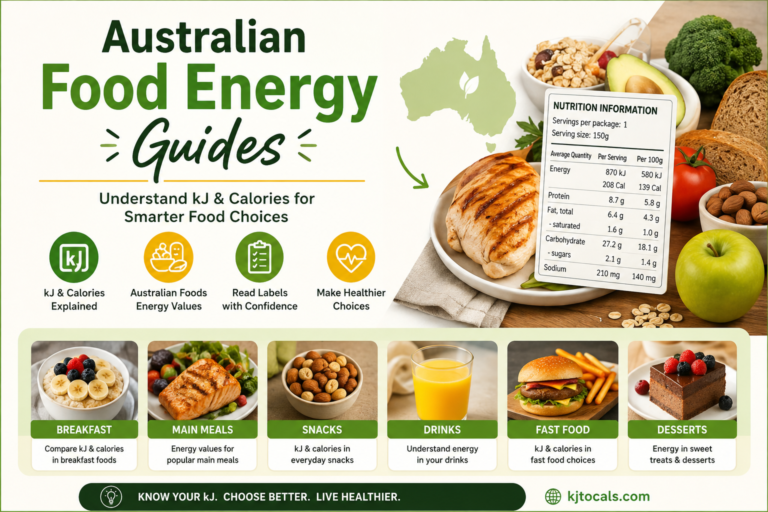
kJ and Calories Are Different Units
Calories are another way of expressing food energy.
The relationship is approximately the following:
- 1 calorie = 4.184 kJ
Australian government nutrition information may use a slightly rounded relationship of around 4.2 kJ per kilocalorie.
For practical conversions, the more precise calculation is
- Calories = kJ ÷ 4.184
For example:
- 1,000 kJ ÷ 4.184 = 239.01 calories
So:
1,000 kJ ≈ 239 calories
You can use this same calculation for any energy value.
Quick kJ-to-calorie examples
Here are a few numbers that are useful when reading Australian food labels:
- Energy Approx. calories
100 kJ, 24 calories
200 kJ, 48 calories
300 kJ, 72 calories
400 kJ, 96 calories
500 kJ 120 calories
600 kJ, 143 calories
700 kJ, 167 calories
800 kJ, 191 calories
900 kJ, 215 calories
1,000 kJ, 239 calories
1,200 kJ, 287 calories
1,500 kJ, 359 calories
2,000 kJ, 478 calories
2,500 kJ, 598 calories
3,000 kJ 717 calories
4,000 kJ, 956 calories
5,000 kJ, 1,195 calories
These figures are rounded to make them easier to read.
How to Convert kJ to Calories
If you want to convert a food label yourself, the calculation is straightforward.
Formula
- Calories = kJ ÷ 4.184
Let’s say your cereal box shows the following:
- 1,600 kJ
Calculate:
- 1,600 ÷ 4.184 = 382.41
So:
- 1,600 kJ ≈ 382 calories
Another example:
750 ÷ 4.184 = 179.25
Therefore:
750 kJ ≈ 179 calories
If you regularly need these calculations, using a kJ-to-calories converter is much quicker than doing the math manually.
How to Convert Calories Back to kJ
The calculation works in the opposite direction too.
If you have calories and want to know the equivalent in kilojoules:
- kJ = calories × 4.184
For example:
- 300 calories × 4.184 = 1,255.2 kJ
So:
- 300 calories ≈ 1,255 kJ
A few common conversions:
- Calories Approx. kj
50 209 kJ
100 418 kJ
150 628 kJ
200,837 kJ
250.146 kJ
300.1255 kJ
400 1,674 kJ
500 2,092 kJ
750 kJ 3,138 kJ
1,000, 4,184 kJ
What Is a Nutrition Information Panel?
The Nutrition Information Panel, often shortened to NIP, is the section on a food label that provides key nutrition information.
For most packaged foods that require one, the panel includes energy and information such as protein, fat, saturated fat, carbohydrate, sugars and sodium.
The layout is designed to give you two useful ways of looking at the food:
- Quantity per serving
and
- Quantity per 100 g or 100 mL
For solid foods, the standard comparison is generally per 100 g. For liquids, it is per 100 mL.
This is one of the most useful things to understand when shopping.
Why the “Per 100 g” Column Matters
Imagine you are choosing between two similar breakfast cereals.
One product has a smaller serving size than the other.
If you compare only the “per serving” numbers, you may think one product contains much less energy.
But the serving sizes might not be equal.
The per 100 g column puts both products on the same basis.
That makes it easier to compare similar foods.
Australian food-label guidance specifically recommends using the per-100-g information when comparing similar packaged foods.
What Does “Per Serving” Mean?
A serving is the amount defined by the food business for that product.
For example:
- a packet might say:
- Servings per package: 4
- Serving size: 50 g
Then the energy shown under “per serving” applies to 50 g.
That does not necessarily mean 50 g is the amount everyone will eat.
Your actual portion could be smaller or larger.
This is why it is useful to check both the serving size and the number of servings in the package.
A Simple Serving-Size Example
Imagine a snack has:
- 700 kJ per serving
and the packet contains three servings.
One serving is approximately:
- 700 ÷ 4.184 = 167 calories
If you eat all three servings:
- 700 × 3 = 2,100 kJ
That is approximately
- 502 calories
The conversion did not change. The amount you ate changed.
This is one of the easiest mistakes to make when looking at a food label.
Per 100 g vs. Per Serving: Which Should You Use?
It depends on what you are trying to find out.
If you want to know how much energy is in the portion you are about to eat, the per-serving column can be useful.
If you want to compare two similar products, the per-100-g column is usually easier.
For example:
- Product A: 450 kJ per 100 g
Product B: 620 kJ per 100 g
Product A provides less energy per 100 g.
The comparison is straightforward because both figures describe the same amount of food.

What Does Energy in Food Actually Mean?
Food provides energy that the body uses for many functions.
Energy is needed for basic processes that keep the body working, physical activity, maintaining body temperature, growth and other physiological functions. Australian dietary guidance identifies carbohydrates, protein and fat as major sources of energy, with alcohol also contributing energy.
So when a label lists energy in kJ, it is not describing a nutrient like protein or vitamin C.
It is telling you about the energy available from the food.
Which Nutrients Provide Energy?
The main energy-providing components of food include:
- Carbohydrates
Protein
Fat
Alcohol
Dietary fiber can also contribute energy under the methods used for Australian food-energy calculations.
Different nutrients provide different amounts of energy per gram.
That is one reason two foods with the same weight can have very different energy values.
Why Some Foods Have More kJ Than Others
A foods energy value depends on what it contains and how much of it you are eating.
For example:
- foods higher in fat can have a relatively high energy value because fat provides more energy per gram than protein or carbohydrate.
That does not mean you can judge a food only by its kJ number.
The rest of the nutrition panel matters too.
A sensible comparison may include:
- Energy
Protein
Total fat
Saturated fat
Carbohydrate
Sugars
Sodium
Fibre, where listed
The best choice depends on your overall dietary needs and the type of food you are comparing.
How to Read an Australian Food Label
You do not need to study the entire package every time you shop.
A quick look at a few sections can tell you a lot.
- Check the serving size
Find out how much the manufacturer considers one serving.
- Look at the number of servings
A package that looks like one portion may actually contain several servings.
- Compare energy
Check the kJ figure per serving and, when comparing products, the value per 100 g or 100 mL.
- Look at the other nutrients
Energy is only one part of the nutrition panel.
- Check the ingredients
The ingredients list can give additional information about what the product contains.
Most packaged-food ingredients are listed in descending order by weight.

Why the Ingredients List Is Useful
The nutrition panel tells you quantities of key nutrients.
The ingredients list tells you what the product is made from.
These two sections work together.
For example:
- a product might carry a claim such as “low fat.” That does not automatically mean it is lower in energy than every similar product.
Healthdirect notes that nutrition claims should be checked against the Nutrition Information Panel rather than taken on their own.
The same idea applies to claims such as “high fiber,” “reduced salt,” or “low sugar.”
Read the actual numbers.
What Is a Daily Energy Intake?
You may see daily energy figures when reading Australian nutrition information.
A commonly used reference value is 8,700 kJ per day for an average adult, but this is not a personal target for every individual. Australian guidance makes clear that energy needs vary between people.
- Age, body size, activity level and other factors can affect energy requirements.
So it is better to treat general daily figures as reference information rather than a number that everyone must follow.
- 8,700 kJ in Calories
For a simple unit conversion:
- 8,700 kJ ÷ 4.184 ≈ 2,079 calories
So the commonly used 8,700 kJ reference is roughly equivalent to 2,080 calories.
Again, this is a unit conversion, not a recommendation that every adult should consume exactly this amount.
Why Energy Needs Are Different for Everyone
There is no single energy requirement that fits every person.
Someone who is physically active may use more energy than someone with a less active lifestyle.
Children and teenagers have different needs from adults and pregnancy and breastfeeding can also affect energy requirements.
Healthdirect notes that daily kilojoule needs can vary according to factors including age and activity.
This is why online calorie or kJ numbers should not be treated as personalized dietary advice.
Can You Use kJ and Calories Interchangeably?
You can convert one into the other, but you should not mix the units without checking which one you are looking at.
For example:
- 1,000 kJ ≈ 239 calories
If one website says a food contains 1,000 kJ and another says it contains 239 calories, those figures may actually describe the same energy.
The key is recognizing the unit.
Common kJ-to-Calorie Conversions
Here are some additional values:
- kJ Calories
250 60
350 84
450 108
550 132
650 155
850 203
950 227
1,100 263
1,300 311
1,400 335
1,600 382
1,700 406
1,900 454
2,200 526
2,500 598
2,800 669
3,500 837
Values are rounded to the nearest calorie.
- Common Mistakes When Reading Food Energy
Mistake 1: Looking only at the front of the package
Marketing claims can catch your attention, but the Nutrition Information Panel gives you the actual nutrition figures.
- Mistake 2: Ignoring serving size
A large packet may contain several servings.
- Mistake 3: Comparing unequal portions
Use the per-100-g or per-100-mL column when comparing similar products.
- Mistake 4: Assuming kJ and calories are unrelated
They measure the same type of thing energy but use different units.
- Mistake 5: Treating general daily figures as personal targets
Individual energy requirements vary.
Is Lower kJ Food Always Better?
Not necessarily.
A lower energy number by itself does not tell you whether a food is the right choice for your diet.
You also need to consider the food’s nutritional value, serving size and how it fits into your overall eating pattern.
Australian dietary guidance focuses on overall healthy eating patterns rather than judging individual foods by one number alone.
This is why the Nutrition Information Panel is more useful when you look at the complete picture.
How the Energy Number Is Calculated
Food energy is not simply guessed from the package.
Australian nutrition calculations can use the amounts of protein, fat, available carbohydrate, dietary fibre, alcohol and certain organic acids, together with established energy factors.
That is why the energy value on a label can sometimes differ slightly from a simple calculation based on only protein, carbohydrate and fat.
Different databases and calculation methods can also produce small differences.
Frequently Asked Questions
What does kJ stand for?
kJ stands for kilojoule, a unit used to measure energy.
Why do Australian food labels use kilojoules?
Kilojoules are the commonly used unit for food energy in Australia.
How many calories are in 1,000 kJ?
1,000 kJ is approximately 239 calories.
How many kJ are in 100 calories?
100 calories is approximately 418 kJ.
What is the formula for kJ to calories?
Divide the kJ value by 4.184.
What is the formula for calories to kJ?
Multiply the calorie value by 4.184.
What does “per 100 g” mean?
It shows the nutrition amount in 100 g of the food and provides a common basis for comparing similar products.
Why is serving size important?
The serving size tells you how much food the “per serving” figures apply to. It can differ between products.