
1200 kJ to Calories: What Does It Mean for Food Energy?
Seeing 1200 kJ on a food label can look like a big number, especially if you are more used to seeing calories. The good news is that the two numbers measure the same thing: energy.
- For food, 1200 kJ is about 287 Calories.
That simple conversion is useful when you are checking Australian food labels, comparing meals or trying to understand how much energy a particular food provides. But the number becomes more useful when you know what it represents and how the serving size affects it.
This guide explains 1200 kJ in plain language and shows how to read that figure in everyday food situations.
The Quick Answer
The standard conversion is:
- 1 food Calorie = 4.184 kJ
So:
- 1200 ÷ 4.184 = 286.8 Calories
Rounded to the nearest whole number:
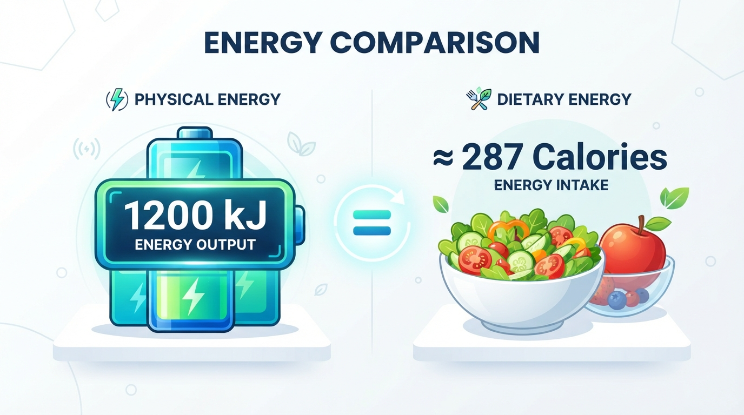
1200 kJ ≈ 287 Calories
You may also see the result written as 286.8 kcal. On food labels, “Calories” normally means kilocalories, so 286.8 kcal and about 287 Calories refer to the same amount of food energy.
| Energy | Approximate equivalent |
|---|---|
| 1200 kJ | 287 Calories |
| 1200 kJ | 286.8 kcal |
| 1200 Calories | 5,021 kJ |
| 100 kJ | 24 Calories |
| 500 kJ | 120 Calories |
| 1000 kJ | 239 Calories |
| 1500 kJ | 359 Calories |
| 2000 kJ | 478 Calories |
- Small differences can appear because food labels often round their numbers.
Why Food Labels Use kJ
People in Australia commonly see kilojoules (kJ) when they check packaged food.
Kilojoule is a unit of energy. Calories are another way of expressing energy. Neither one tells you whether a food is healthy or unhealthy by itself.
For example:
a label might show:
- Energy: 1200 kJ
Someone familiar with calories may find that number hard to judge. Converting it gives a more familiar figure:
- 1200 kJ ≈ 287 Calories
This is especially helpful when comparing information from different countries. Some websites, meal plans, apps and nutrition resources use Calories, while Australian packaging commonly displays kJ.
The conversion lets you move between the two systems without changing the actual amount of energy.
1200 kJ Is Not 1200 Calories
This is one of the easiest mistakes to make.
The number 1200 appears in both expressions, but the units are different.
- 1200 kJ ≠ 1200 Calories
Instead:
- 1200 kJ ≈ 287 Calories
That is because a food Calorie is a much larger unit than a kilojoule.
A useful way to remember the relationship is:
- Divide kJ by 4.184 to get Calories.
So if you have a food label showing 1200 kJ, you do not need to treat it as 1200 Calories.
A Simple Way to Understand the Number
Imagine you pick up a packaged meal and the nutrition panel says:
- Energy per serving: 1200 kJ
You can read that as roughly:
- 287 Calories per serving
Now imagine the package contains two servings.
The label may still show 1200 kJ, but that could mean one serving, not the entire package.
If you eat both servings:
- 1200 kJ × 2 = 2400 kJ
And:
- 2400 kJ ≈ 574 Calories
This is why the serving information matters just as much as the energy number.
The Serving Size Can Change the Result
A food label may provide energy information in several ways.
You could see:
- per serving
- per 100 g
- per package
- sometimes per portion
These figures are not interchangeable.
Suppose a snack says:
- 1200 kJ per 100 g
That does not automatically mean your snack contains 1200 kJ. You need to know how much you actually eat.
If your portion is 50 g:
- 1200 × 0.5 = 600 kJ
That is about:
- 143 Calories
If you eat 150 g:
- 1200 × 1.5 = 1800 kJ
That is about:
- 430 Calories
So the same product can provide very different amounts of energy depending on the amount consumed.
What 1200 kJ Means on an Australian Label
Australian nutrition panels often make comparisons easier by giving information per 100 g or 100 mL.
Consider a made-up example:
| Nutrition information | Per 100 g |
|---|---|
| Energy | 1200 kJ |
| Protein | 10 g |
| Fat | 15 g |
| Carbohydrate | 25 g |
The 1200 kJ figure describes the energy contained in 100 g of that food.
If you eat only 40 g, your intake is not 1200 kJ.
You would calculate:
- 1200 × 0.40 = 480 kJ
That works out to roughly:
- 115 Calories
This small example shows why reading the words next to the number is important.
What If 1200 kJ Is Per Serving?
Now consider a different label.
The package says:
- Energy per serving: 1200 kJ
and below it:
- Servings per package: 2
Here, one serving gives approximately 287 Calories.
Eating the complete package would provide approximately:
- 574 Calories
The conversion itself has not changed. What changed was the amount of food eaten.
Whenever you see an energy figure, check the serving information before using the number in your calculations.
Is 1200 kJ a Lot of Energy?
There is no single answer for everyone.
The amount of energy a person needs depends on many factors, including body size, age, activity and other individual circumstances.
For that reason, it is not useful to label 1200 kJ as automatically “high” or “low” without knowing the context.
For one food, 1200 kJ might represent a complete meal. For another product, it could describe a large portion of a snack or dessert.
The food itself also matters.
Two foods can contain the same 1200 kJ but have very different amounts of protein, fat, carbohydrate, fibre, vitamins and minerals.
So the energy figure is only one part of the nutrition picture.
1200 kJ in Different Types of Food
A useful way to think about 1200 kJ is to imagine it as an energy amount rather than a particular type of food.
The number could appear beside:
- a ready-made meal
- a bakery item
- a sweet snack
- a restaurant meal
- a breakfast
- a drink
- a combination of several smaller foods
The label does not tell you what the food is simply from its energy value.
For example:
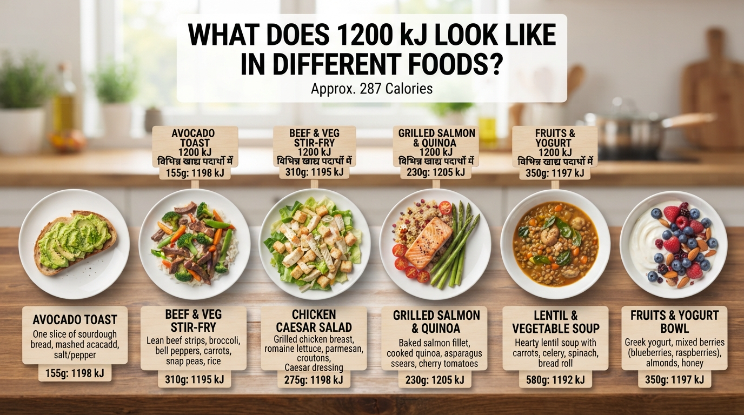
- two different meals could each provide around 1200 kJ. One might contain more protein and vegetables, while the other could contain more added sugar or fat.
That is why calorie or kJ comparisons work best when they are combined with the rest of the nutrition panel.
Energy and Weight Management
People often convert kJ to Calories because they are tracking their food intake.
The conversion can make food records easier to understand, particularly when different sources use different energy units.
For example:
- Breakfast: 1200 kJ
Lunch: 1800 kJ
Snack: 600 kJ
Total:
- 3600 kJ
Converting that amount:
- 3600 ÷ 4.184 ≈ 861 Calories
The calculation simply changes the unit. It does not change the amount of energy consumed.
For personal nutrition targets, however, a suitable energy intake varies from person to person. A general conversion should not be treated as a personal diet recommendation.
Why 1200 kJ Can Look Confusing
The difference between kJ and Calories becomes easier to understand when you compare several numbers.
| kJ | Calories |
|---|---|
| 200 kJ | 48 Calories |
| 400 kJ | 96 Calories |
| 600 kJ | 143 Calories |
| 800 kJ | 191 Calories |
| 1000 kJ | 239 Calories |
| 1200 kJ | 287 Calories |
| 1400 kJ | 335 Calories |
| 1600 kJ | 382 Calories |
| 1800 kJ | 430 Calories |
| 2000 kJ | 478 Calories |
- This table is based on the standard conversion and rounded to the nearest whole Calorie.
- You can use the same method for other values without memorising every result.
The Formula Behind the Conversion
There is no special 1200 kJ rule.
The normal conversion is used:
- Calories = kJ ÷ 4.184
For 1200 kJ:
- 1200 ÷ 4.184 = 286.8
Therefore:
- 1200 kJ = approximately 287 Calories
To go in the opposite direction:
- kJ = Calories × 4.184
For example:
- 287 × 4.184 ≈ 1200 kJ
The two formulas are simply reverse versions of each other.
Why Your Calculator May Show 286.8
You may get a decimal result rather than a whole number.
That is normal.
The exact calculation gives about 286.8 kcal. When a food label or nutrition guide uses whole numbers, it may be rounded to 287 Calories.
Another website might display 286.77, 286.8 or 287 depending on how many decimal places it keeps.
These small differences do not mean the conversion is wrong.
They are usually just differences in rounding.
1200 kJ Compared With Other Common Amounts
Sometimes the easiest way to understand an energy value is to place it beside nearby figures.
- 1000 kJ
1000 kJ is about 239 Calories.
So moving from 1000 kJ to 1200 kJ adds around 48 Calories.
- 1500 kJ
1500 kJ is about 359 Calories.
That is roughly 72 Calories more than 1200 kJ.
- 2000 kJ
2000 kJ is about 478 Calories.
This makes 1200 kJ noticeably smaller than 2000 kJ when both figures refer to the same serving size.
These comparisons are useful when reading menus or food labels, but they only make sense when the amounts are measured on the same basis.
What About 1200 kJ in Drinks?
Energy can also come from drinks.
A bottle or cup might list an energy value based on 100 mL, one serving or the whole container.
Suppose a drink contains:
- 1200 kJ per bottle
That bottle provides around 287 Calories.
But if the label says:
- 1200 kJ per 100 mL
and the bottle contains 500 mL, the total would be much higher:
- 1200 × 5 = 6000 kJ
That is about 1434 Calories.
This example shows why you should never look at the energy number alone. Always check whether it applies to 100 mL, one serving or the complete bottle.
Food Energy Is Only One Part of Nutrition
The kJ or calorie figure tells you about energy, but it does not describe the whole food.
A nutrition panel can also include information such as:
- protein
- total fat
- saturated fat
- carbohydrates
- sugars
- sodium
- dietary fibre
Depending on the product and label, other nutrients may also be listed.
Two products with 1200 kJ can therefore be quite different nutritionally.
One might be a meal with protein, vegetables and fibre. Another might be a snack with a very different nutrient profile.
The shared energy value does not make the foods nutritionally identical.
Common Mistakes With 1200 kJ
A few simple mistakes can lead to incorrect calculations.
Treating kJ as Calories
The biggest mistake is reading 1200 kJ as 1200 Calories.
The correct conversion is about 287 Calories.
Ignoring the serving size
If 1200 kJ is listed per 100 g, eating 50 g does not give you the full 1200 kJ.
Forgetting multiple servings
A packet containing two servings can provide twice the listed serving energy if you eat the entire packet.
Rounding too early
Keeping the decimal result until the end gives a cleaner calculation.
Comparing different serving sizes
A 1200 kJ serving cannot be fairly compared with a 1200 kJ-per-100-g figure unless you first put the numbers on the same basis.
A Quick Real-Life Example
Imagine you are checking a frozen meal.
The label says:
Serving size: 300 g
Energy per serving: 1200 kJ
You can immediately convert that to approximately:
287 Calories per 300 g serving
Now suppose the package contains two servings.
The complete 600 g package would provide:
2400 kJ
or about:
574 Calories
This is a practical reason to understand both the conversion and the serving information. The number printed on the front of a package may not represent everything inside the package.
Can You Estimate 1200 kJ Without a Calculator?
Yes, you can make a quick estimate.
Since:
- 1 Calorie ≈ 4.184 kJ
you can divide 1200 by a little more than 4.
That puts the answer close to 300 Calories.
The more accurate result is:
- 287 Calories
For everyday label reading, this estimate can help you understand the general size of the energy value. For precise tracking, use 4.184 or a reliable converter.
1200 kJ to Calories: The Bottom Line
The main conversion is simple:
- 1200 kJ ≈ 287 Calories
The important part is understanding what that number refers to.
If 1200 kJ is listed per serving, around 287 Calories applies to that serving.
If it is listed per 100 g, the result applies to 100 g.
If a package contains several servings, eating the entire package can give you considerably more energy than the number shown for one serving.
The kJ-to-Calorie conversion is simply a change in units. It does not tell you whether a food is good or bad and it does not replace the rest of the nutrition information.
Frequently Asked Questions
How many Calories are in 1200 kJ?
Is 1200 kJ the same as 1200 Calories?
No. 1200 kJ is about 287 Calories. Kilojoules and Calories are different units used to measure energy.
What is the formula for 1200 kJ to Calories?
Divide the kJ value by 4.184:
1200 ÷ 4.184 = 286.8 Calories
Rounded, that is about 287 Calories.
Is 1200 kJ a meal?
It can be. Whether 1200 kJ represents a meal, snack, or part of a meal depends on the food and serving size.
How many Calories are in 1200 kJ per 100 g?
If a food contains 1200 kJ per 100 g, then 100 g provides approximately 287 Calories.
How many Calories are in 1200 kJ of food?
Approximately 287 Calories, assuming the full 1200 kJ is the amount being consumed.
Why do Australian labels use kJ?
Kilojoules are commonly used on Australian food labels to express food energy. Calories are another energy unit that you may see in international nutrition information.
Can 1200 kJ be part of a daily energy intake?
Yes. It can represent one meal, several smaller foods or another portion of a person’s daily energy intake. Individual energy needs vary.
Why does my answer differ slightly from another calculator?
Most likely because of rounding. The exact conversion gives about 286.8 Calories, while some calculators round the result to 287.