
1000 kJ to Calories: Quick Conversion Guide
You are checking a food label and the number says 1000 kJ. Then you look again because you normally think about food in calories.
So, what does 1000 kJ actually mean?
- The short answer is about 239 calories.
That is the number most people are looking for. But if you live in Australia or regularly check Australian food labels, knowing how to make the conversion yourself can be useful. You will come across kJ all the time and the numbers can look much bigger than the calorie values you are used to seeing.
For example:
- A snack showing 1000 kJ is not a 1000-calorie snack. It is closer to 239 calories.
Lets make the whole thing easy to understand.
1000 kJ :How Many Calories?
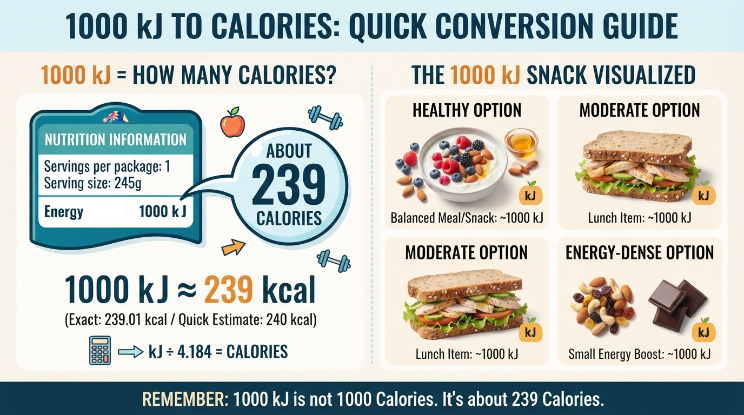
- 1000 kJ is approximately 239 calories (kcal).
The exact calculation gives a result of around 239.01 kcal, so it is normally rounded to 239 calories.
For a quick estimate, you can also call it 240 calories. The one calorie difference is very small and usually does not matter when you are simply comparing foods.
Here is the basic conversion:
- 1000 kJ ÷ 4.184 = 239.01 kcal
So, if you see 1000 kJ on a food package, remember:
- 1000 kJ ≈ 239 calories
That is really all there is to the main calculation.
The Easy Calculation
If you want to convert a kJ number yourself, you only need one formula:
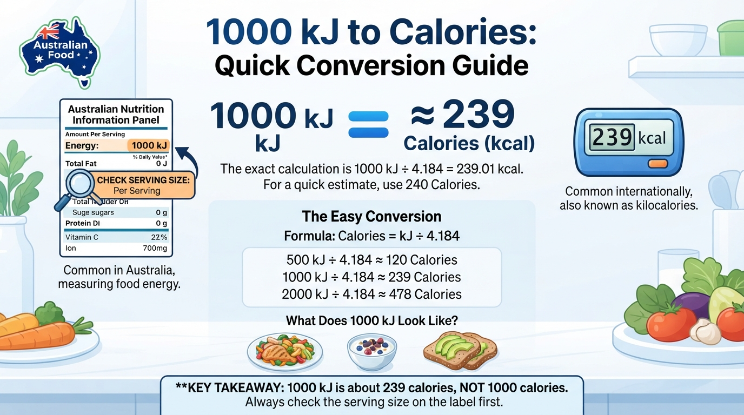
- Calories = kJ ÷ 4.184
Lets put 1000 into the formula.
- 1000 ÷ 4.184 = 239.01
Rounded:
- 239 calories
You can use exactly the same method for other values.
For example:
- 500 kJ ÷ 4.184 = about 120 calories
And:
- 2000 kJ ÷ 4.184 = about 478 calories
Once you know the formula, you do not need a separate calculation for every food.
A Quick Look at Common Values
If you are reading food labels regularly, these numbers are handy to have around.
| Kilojoules | Approx. calories |
|---|---|
| 100 kJ | 24 |
| 200 kJ | 48 |
| 300 kJ | 72 |
| 400 kJ | 96 |
| 500 kJ | 120 |
| 600 kJ | 143 |
| 700 kJ | 167 |
| 800 kJ | 191 |
| 900 kJ | 215 |
| 1000 kJ | 239 |
| 1100 kJ | 263 |
| 1200 kJ | 287 |
| 1500 kJ | 359 |
| 2000 kJ | 478 |
| 2500 kJ | 598 |
| 3000 kJ | 717 |
The figures are rounded to make them easier to use.
What Is a Kilojoule?
- A kilojoule, written as kJ, is a measurement of energy.
Your body needs energy all day long. You use it when you walk, exercise, work, digest food, breathe and even when you are asleep.
- Food gives your body that energy.
- In Australia, kilojoules are commonly used on nutrition labels. So instead of seeing something like “239 calories,” you may see “1000 kJ.”
It can take a little time to get used to.
The food has not suddenly become more energetic. You are simply looking at its energy using a different unit.
What Is a Calorie?
A calorie is another way of measuring energy.
When people talk about calories in food, they are normally talking about kilocalories or kcal.
You may see both words used:
- calories
- kcal
- kilocalories
In everyday food and nutrition conversations, “calories” generally means kilocalories.
So these two descriptions represent roughly the same thing:
- 239 calories
and
- 239 kcal
That is why calorie counters and nutrition apps usually use kcal or calories without making the distinction a big issue.
Why Australian Labels Can Be Confusing
If you are used to American websites, calorie-counting apps or recipes that list calories, an Australian nutrition label can look a little strange.
You might see:
- Energy: 1000 kJ
while another website describes the same amount of energy as:
- 239 calories
At first glance, those numbers look completely unrelated.
They are not.
They are simply two measurements of the same energy.
Once you remember that 1000 kJ is around 239 calories, the numbers start to make much more sense.
Do not Forget the Serving Size
This is actually more important than the conversion itself.
Imagine you buy a snack and the nutrition panel says:
- Energy per serving: 1000 kJ
That serving contains about 239 calories.
But suppose there are three servings in the package and you eat the entire package.
- You have not eaten 239 calories.
You have eaten approximately:
- 3000 kJ
which works out to around:
- 717 calories
The calculation is easy. The part people often miss is the serving information.
Before converting anything, look at the words around the energy number.
- Does it say per serving, per 100 g or something else?
That tells you what the number actually represents.
Per Serving vs Per 100 g
These two figures are easy to mix up.
- A label might show:
| Nutrition information | Energy |
|---|---|
| Per serving | 1000 kJ |
| Per 100 g | 500 kJ |
If you eat one stated serving, the 1000 kJ figure is the one that matters.
The per-100-g number is useful when you want to compare two different products. It gives you the same reference amount for both foods.
For instance, one cereal might have 1500 kJ per 100 g and another might have 1700 kJ per 100 g. Comparing those figures gives you a clearer idea of which one is more energy-dense.
So do not just look at the biggest number on the label. Check what it is measuring.
Is 1000 kJ a Lot?
There is no universal answer.
- We know that 1000 kJ is around 239 calories, but whether that feels like a lot depends on the food and your overall diet.
For some people, 1000 kJ might be part of a main meal. For someone else, it could be a snack or a drink.
The food itself matters too.
- A plate full of vegetables, lean protein and grains can have a similar energy value to a much smaller food that contains more fat and sugar.
So the kJ number tells you about energy. It does not tell you everything about the food.
Does 1000 kJ Mean 1000 Calories?
No.
This is probably the easiest mistake to make when first learning about kilojoules.
- 1000 kJ is about 239 calories, not 1000 calories.
A few examples make the difference clearer:
- 500 kJ → about 120 calories
- 1000 kJ → about 239 calories
- 1500 kJ → about 359 calories
- 2000 kJ → about 478 calories
- 3000 kJ → about 717 calories
The kJ figure may look large, but that does not mean the calorie value is equally large.
What Does 1000 kJ Look Like in Food?
There is no single food that represents exactly 1000 kJ.
Energy content changes depending on ingredients, cooking methods and portion size.
For example:
- nuts are fairly energy-dense, so a relatively small amount can provide a noticeable amount of energy. Vegetables contain much less energy per gram, so you can have a larger physical portion for the same general energy range.
A meal containing chicken, rice and vegetables might also reach around 1000 kJ depending on the quantities.
This is why it is better to think of 1000 kJ as a measurement, rather than imagining one specific food portion.
Does the Source of the Calories Matter?
Yes, if you are looking at overall nutrition.
Two foods can both contain about 239 calories and still be very different.
One might provide protein, fiber, vitamins and minerals. Another might mainly provide energy from added sugar or fat.
Calories are useful when you want to understand energy intake, but they are not a complete description of a food.
When comparing products, take a look at the rest of the nutrition panel too.
You may want to check:
- protein
- carbohydrates
- sugars
- total fat
- saturated fat
- fiber
- sodium
The right choice depends on your own needs and the rest of your diet.
1000 kJ and Daily Food Intake
You can also use the conversion when adding up your food for the day.
Imagine your meals and snacks add up to:
- 8000 kJ
To convert that total:
- 8000 ÷ 4.184 ≈ 1912 calories
So 8000 kJ is roughly 1912 calories.
You can do this with any total.
If your food diary uses kJ but you prefer thinking in calories, the same formula works every time.
A Few More Useful Conversions
Here are some common values that come up when checking food labels:
| kJ | Approx. calories |
|---|---|
| 750 kJ | 179 |
| 800 kJ | 191 |
| 850 kJ | 203 |
| 900 kJ | 215 |
| 950 kJ | 227 |
| 1000 kJ | 239 |
| 1050 kJ | 251 |
| 1100 kJ | 263 |
| 1150 kJ | 275 |
| 1200 kJ | 287 |
| 1250 kJ | 299 |
| 1300 kJ | 311 |
- These are not meant to replace a precise calculator. They are simply useful when you want a quick idea of what a number on a label means.
Can You Just Multiply by 0.239?
Yes.
If you do not want to divide by 4.184 every time, there is another way.
You can use:
- kJ × 0.239 = calories
For 1000 kJ:
- 1000 × 0.239 = 239 calories
For 1500 kJ:
- 1500 × 0.239 = 358.5 calories
So 1500 kJ is about 359 calories.
This method is convenient if you are using a calculator or spreadsheet.
For mental maths, it may be easier to remember that every 1000 kJ is roughly 239 calories.
A Simple Mental Shortcut
If you are standing in a supermarket and do not want to open a calculator, you can use a rough estimate.
Think:
- 1000 kJ ≈ 240 calories
Then work from there.
For example:
- 2000 kJ is about 480 calories using the quick estimate.
The more exact figure is 478 calories.
For normal food comparisons, that small difference usually is not important.
What If the Label Says 990 kJ?
You do not need to worry about finding an exact number in your head.
- 990 kJ is very close to 1000 kJ.
Since 1000 kJ is around 239 calories, 990 kJ is just under that amount, at roughly 237 calories.
The same idea works for numbers such as 980, 1020 or 1050 kJ.
You can make a quick estimate or use the full formula when accuracy matters.
What If the Food Has 1000 kJ Per 100 g?
In that case,
- 100 g of the food provides about 239 calories.
But if you eat 200 g, you would consume twice that amount:
- 2000 kJ ≈ 478 calories
And if you only eat 50 g:
- 500 kJ ≈ 120 calories
This is a good example of why portion size matters.
The 1000 kJ figure is tied to the stated amount of food.
Is 1000 kJ Suitable for a Meal?
It can be.
But there is no single meal size that works for every person.
People have different energy requirements and those needs can change depending on factors such as activity, age, body size and daily routine.
- So it would be misleading to say that 1000 kJ is automatically a “small meal” or a “large meal.”
- It is simply around 239 calories.
What makes up those calories and how they fit into your overall meals are also important.
Can 1000 kJ Help With Weight Management?
- Understanding food energy can certainly help you make sense of nutrition labels.
- However, one number does not determine whether a person gains or loses weight.
- Your overall energy intake, activity, eating habits and individual circumstances all play a role.
- Since 1000 kJ is around 239 calories, it can be useful to know the value when keeping track of your food.
- But there is no special rule that makes 1000 kJ good or bad for weight management.
- Looking at your overall eating pattern is more useful than focusing on one meal or snack.
Calories and kJ Are Just Different Units
This is probably the main idea worth taking away.
If a product says 1000 kJ, it has not suddenly got more energy than a food that says 239 calories.
They describe roughly the same amount of energy.
The difference is the unit being used.
So when you see:
- 1000 kJ
you can mentally translate it to:
- about 239 calories
That one little conversion can make Australian nutrition labels much easier to understand.
Converting Calories Back to kJ
The conversion also works in the other direction.
If you have calories and want to find the kJ value, multiply by 4.184.
For example:
- 239 × 4.184 ≈ 1000 kJ
Another example:
- 500 calories × 4.184 = 2092 kJ
So 500 calories is roughly 2092 kJ.
The reverse formula is:
- kJ = calories × 4.184
It is useful when comparing an Australian food label with a website or app that lists energy in calories.
Why Do Some Calculators Show 240 Calories?
You may search for “1000 kJ to calories” and find a result of 239 on one website and 240 on another.
Do not let that worry you.
The actual calculation is approximately 239.01 kcal.
One calculator may round it to 239.
Another may use a simpler conversion and round it to 240.
Both numbers are extremely close.
For precise calculations, use 239.01 kcal.
For everyday use, 239 or 240 calories is perfectly understandable.
1000 kJ Does Not Tell the Whole Nutrition Story
It is tempting to look at one number and make a quick judgment about a food.
But energy is only one part of nutrition.
Suppose two foods both contain about 1000 kJ.
One could be a meal with vegetables, protein and whole grains. Another could be a small dessert with a higher amount of sugar and fat.
Their energy values may be similar, but the rest of their nutrition can be quite different.
This is why food labels include information about more than energy.
If you are comparing products, take a minute to read the complete label.
The Bottom Line
The conversion is simple:
- 1000 kJ = about 239 calories
If you want an easy number to remember, use 240 calories as a rough estimate.
For an exact calculation, divide the kJ value by 4.184.
The bigger lesson is to pay attention to the serving size too. A label showing 1000 kJ per serving means something very different if you eat two or three servings.
Once you get used to the relationship between kilojoules and calories, numbers on Australian food labels become much less confusing. You can look at 500, 1000, 1500 or 2000 kJ and quickly understand roughly how much energy each one represents.
- 1000 kJ is not 1000 calories. It is about 239 calories.
FAQS
How many calories are in 1000 kJ?
1000 kJ is approximately 239 calories or 239 kcal.
Is 1000 kJ the same as 240 calories?
Almost. The exact value is about 239 calories, so 240 is simply a rounded estimate.
Is 1000 kJ the same as 1000 calories?
No. 1000 kJ is about 239 calories.
How do I calculate 1000 kJ in calories?
Divide the kJ amount by 4.184:
1000 ÷ 4.184 = 239.01 kcal
How many calories are in 500 kJ?
500 kJ is approximately 120 calories.
How many calories are in 1500 kJ?
1500 kJ is approximately 359 calories.
How many calories are in 2000 kJ?
2000 kJ is approximately 478 calories.
How many kJ are in 239 calories?
239 calories are approximately 1000 kJ.
Why do Australian foods show kJ?
Kilojoules are commonly used to show energy on Australian food labels.
Should I use the serving value or the per-100-g value?
Use the value that matches the amount you are interested in. If you eat one serving, check the serving figure. For comparing different products, per 100 g can be more useful.
Is 1000 kJ a healthy amount?
The kJ number alone cannot tell you whether a food is healthy. Look at the whole nutrition label and the ingredients as well.